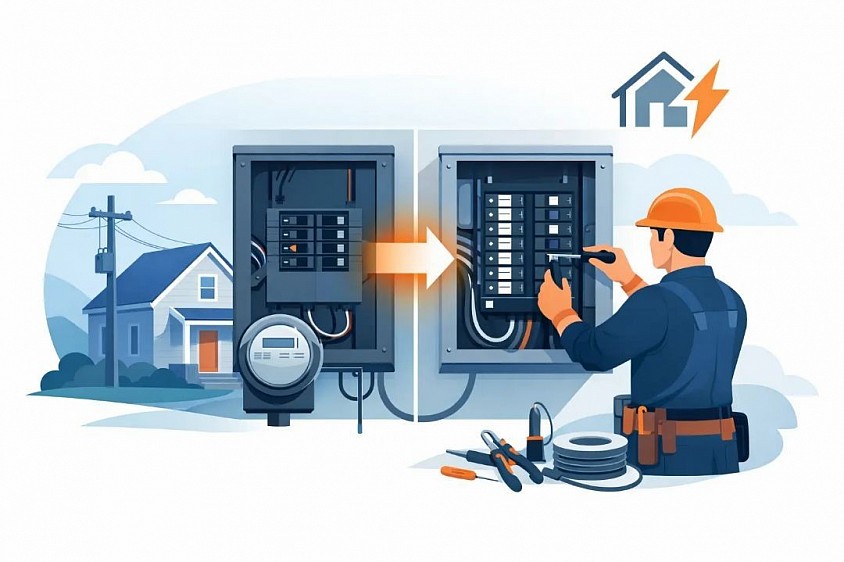
How to Upgrade Home Electrical Service
If your lights dim when the HVAC starts, your panel is full, or you're adding an EV charger, it may be time to look at how to upgrade home electrical service. For many California homeowners, this comes up during a remodel, a generator project, or after years of adding new appliances to a house that was never designed for today's electrical demand.
A service upgrade is not the same as swapping out a few breakers. It usually means increasing the capacity of the electrical service feeding your home, often from 100 amps to 200 amps, and sometimes more depending on the property and planned loads. That can involve the meter, panel, service mast, grounding, utility coordination, permits, and inspection.
The goal is simple: safe, reliable power with enough capacity for the way you actually live.
## When a home electrical service upgrade makes sense
Older homes in particular can outgrow their original service. A panel that worked fine decades ago may now be supporting central HVAC, a heat pump water heater, induction cooking, workshop equipment, hot tubs, home offices, and vehicle charging. Even if the system still functions, that does not mean it is sized well for current use.
One common sign is lack of space in the panel. If breakers are doubled up where they should not be, or every new project starts with the question of where to fit another circuit, the service may already be stretched. Another sign is recurring nuisance tripping, flickering under load, or visible wear at older equipment.
Sometimes the issue is less about current problems and more about future planning. If you're remodeling, adding square footage, installing a backup generator, or preparing for an EV charger, upgrading the electrical service during that work is often more practical than waiting until the system becomes a bottleneck.
## How to upgrade home electrical service the right way
The right approach starts with load planning, not equipment shopping. Homeowners sometimes assume they need the biggest panel available, but service size should be based on the home's real electrical demand, future plans, and code requirements.
A licensed electrician will typically evaluate your existing service size, panel condition, major appliances, HVAC equipment, detached structures, and any planned additions. This matters because a 200-amp upgrade is common, but it is not automatic. Some properties may need more capacity, while others may only need a panel reconfiguration or subpanel solution if the incoming service is already adequate.
From there, the scope gets defined. In many homes, the upgrade includes a new main service panel, new service entrance conductors, updated grounding and bonding, and coordination with the utility company for disconnect and reconnect. If the existing meter equipment is outdated or no longer compliant, that may need to be replaced as well.
This is also the stage where project timing matters. If the home is undergoing a remodel, trenching for site work, or installation of large new loads, it makes sense to coordinate everything together. Doing that can reduce duplicate labor and help avoid rework later.
## What the process usually involves
A service upgrade is part electrical work, part utility coordination, and part inspection process. That is why it needs to be planned carefully.
First comes the site assessment and load calculation. Then the electrician identifies what must be upgraded to meet current code and support the desired service size. In many jurisdictions, permit requirements are straightforward, but the details still matter. California homes can vary widely in age, layout, and existing equipment, so no two upgrades are exactly alike.
Once permits are in motion, the utility may need to approve or schedule portions of the work, especially if service conductors, meter placement, or disconnect procedures are involved. On installation day, power is typically shut off while the old equipment is removed and the new system is installed. For a standard residential upgrade, the outage may be limited to part of a day, but project complexity can change that.
After the installation, the work is inspected. Once approved, the service is re-energized by the utility if required. A clean, code-compliant finish matters here - not just because it looks professional, but because it affects safety, reliability, and the ability to support future electrical additions without problems.
## Choosing the right service size
For many homeowners, the real question is whether to upgrade to 200 amps or plan beyond that. In a lot of cases, 200-amp service is the practical standard because it supports modern living without overbuilding. It gives room for larger HVAC loads, kitchen upgrades, workshop circuits, and EV charging in a way that older 100-amp systems often cannot.
That said, it depends on the property. A larger custom home, an all-electric home, or a property with an ADU, pool equipment, well systems, or multiple high-demand loads may justify more planning. The right answer comes from a proper load calculation, not guesswork.
It is also worth separating service size from panel size. A panel may have many circuit spaces, but that does not automatically mean the service feeding it is sufficient. Likewise, a home can have a crowded panel without necessarily needing a full service upgrade. That is why a qualified evaluation matters before decisions get made.
## Cost factors homeowners should expect
There is no honest flat price for every service upgrade because the job depends on the home and the site. The distance from utility connection points, the condition of existing equipment, panel location, grounding requirements, local permit processes, and whether service entrance components must be relocated can all affect cost.
If the upgrade is part of a larger project, that may improve efficiency. For example, if walls are already open during a remodel or trenching is already happening for other site work, it can be easier to complete related electrical improvements at the same time.
On the other hand, older homes sometimes reveal extra work. Once the panel is opened up, an electrician may find outdated wiring methods, damaged conductors, or prior modifications that need correction before the new service can be finalized. That does not mean the project is off track. It means the system is being brought up safely rather than covered over and left as a future problem.
## Why permits and code compliance matter
Home electrical service is not a place for shortcuts. The service equipment is the backbone of the entire system, and mistakes at this level can affect [fire safety](https://www.northstarelectric.net/electrical_safety_tips.html), shock protection, equipment performance, and insurance issues.
Proper permitting and inspection protect the homeowner as much as the contractor. They help confirm that grounding, bonding, conductor sizing, overcurrent protection, clearances, and equipment ratings are all handled correctly. That becomes especially important when you're adding high-demand loads like EV chargers, electric appliances, or standby power equipment.
It also matters when you sell the property. Unpermitted electrical work has a way of surfacing during real estate transactions, [insurance reviews](https://www.northstarelectric.net/faq-_electrical_questions.html), or later renovations. Doing the work correctly from the start usually saves time, money, and frustration down the road.
## Planning for future electrical needs
One of the best reasons to upgrade service is to stop reacting and start planning. If you know a remodel is coming, or your household is moving toward more electric equipment, this is the time to think beyond today's panel issue.
Maybe you want an EV charger now and a backup generator later. Maybe you're converting to electric cooking, adding mini-splits, or finishing a garage workshop. Those projects all depend on available capacity and a properly designed distribution system.
A thoughtful service upgrade can create room for those additions while keeping the installation organized and code-compliant. That is especially valuable on properties where multiple improvements may happen over several years.
For homeowners who want reliable, professionally managed work, Northstar Electric approaches service upgrades with the same focus it brings to remodels, generator installations, EV charging, and [full-scope electrical projects](https://www.northstarelectric.net/services.html) - careful planning, precise workmanship, and responsive local service.
## What to do before you schedule the work
Before reaching out for an estimate, it helps to make a simple list of what's changing in the home. Include major appliances, HVAC upgrades, EV chargers, remodel plans, detached buildings, or any backup power goals. If you have noticed tripping breakers, flickering lights, or panel crowding, mention that too.
Photos of the existing panel, meter area, and service entrance can also help during early conversations, though an on-site evaluation is still the best way to confirm scope. The more clearly your goals are defined, the easier it is to recommend a service size and upgrade path that actually fits the property.
A home electrical service upgrade is not just about getting more amps. It is about building a safer, more capable system that matches how your home works now and where it is headed next. If your electrical system is holding back a remodel, a new appliance, or a future-ready plan, that is usually the right time to start the conversation.