Blog page
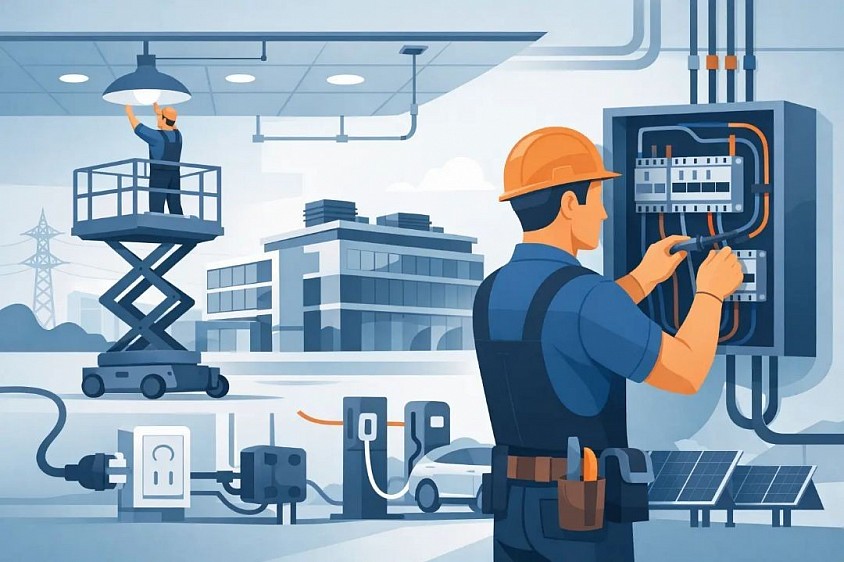
Commercial Electrical Installations
A commercial project can look finished on the surface and still carry electrical problems that show up later - overloaded panels, poor lighting layout, undersized conduit, or equipment that never performs the way it should. That is why commercial electrical installations need more than basic wiring. They need planning, code knowledge, accurate load calculations, and clean execution from the ground up.
For business owners, builders, and property managers, the electrical scope affects almost everything else on the job. It shapes construction timelines, inspection outcomes, operating costs, tenant satisfaction, and long-term safety. When the installation is done right, the building works the way it is supposed to. When corners are cut, the problems tend to be expensive and hard to ignore.
What commercial electrical installations actually include
Commercial work covers much more than running wire and setting fixtures. In many buildings, the electrical system is a layered network that supports lighting, receptacles, dedicated equipment, service panels, distribution, emergency systems, and site infrastructure. Depending on the property, that may also include LED upgrades, emergency egress lighting, backup power connections, EV chargers, underground conduit runs, transformers, switchgear, and service equipment sized for future expansion.
The right scope depends on the building use. A retail space has different needs than an office, restaurant, warehouse, school, or mixed-use property. Tenant improvement work also brings its own challenges, especially when existing electrical conditions are undocumented or no longer match the current demands of the space.
That is where experience matters. Commercial jobs often involve coordination with other trades, utility requirements, permitting, trenching, inspection scheduling, and material lead times. A contractor needs to understand the full picture, not just one piece of it.
Why planning matters before the first wire is pulled
Electrical problems on commercial jobs rarely start at trim-out. They usually start much earlier, when decisions are rushed or assumptions are made about load, layout, equipment, or usage. A panel may look adequate on paper until the owner adds refrigeration, heavier machinery, more IT equipment, or EV charging. Lighting may meet minimum requirements but still leave work areas uneven or inefficient. Underground infrastructure may be installed without enough capacity for future needs.
Good planning reduces those risks. It starts with a clear understanding of how the building will actually be used, both now and later. That includes service size, distribution needs, equipment specifications, lighting goals, occupancy requirements, and any emergency power considerations. It also means looking at access, scheduling, and whether the job is new construction, a remodel, or an occupied space.
Every project has trade-offs. Oversizing every component can drive up cost unnecessarily, but building too tightly to current demand can limit growth and create expensive rework. The best commercial electrical installations strike the right balance between present needs, code compliance, and practical future flexibility.
New construction, remodels, and tenant improvements are different jobs
A ground-up commercial build offers the cleanest starting point. Systems can be designed around the structure, equipment, and intended use from day one. Even then, timing matters. Underground work, conduit placement, service coordination, and rough-in all have to align with the broader construction schedule.
Remodels are less predictable. Existing panels may be full, older wiring may need correction, and previous modifications may not meet current standards. In some buildings, the electrical service is technically functioning but no longer suitable for how the space operates. That can affect budget and schedule quickly.
Tenant improvements sit somewhere in the middle. The shell may already be in place, but the space still needs electrical systems tailored to the tenant’s use. A salon, medical office, restaurant, and general office suite all have very different power and lighting needs. Treating them the same usually leads to change orders or performance issues later.
Code compliance is the baseline, not the finish line
Commercial electrical work has to meet code. That part is non-negotiable. But passing inspection should not be the only goal.
A code-compliant system can still be frustrating to use if circuits are poorly distributed, lighting is inconsistent, service access is awkward, or equipment placement makes maintenance harder than it should be. Strong commercial work takes compliance seriously while also thinking about serviceability, durability, and the day-to-day realities of the building.
This matters even more in high-demand environments. Restaurants, shops, industrial spaces, and multi-tenant properties put real stress on electrical systems. If the installation is not organized, labeled, and built with care, troubleshooting later becomes slower and more expensive.
Lighting is one of the most visible parts of a commercial installation
Lighting has a direct effect on safety, energy use, appearance, and how people experience a space. In commercial settings, it is not just about brightness. Fixture type, placement, controls, emergency egress coverage, and efficiency all need to work together.
LED lighting has become the standard choice for many commercial properties because it lowers maintenance needs and operating costs. Still, not every LED layout is a good one. The wrong fixture selection can create glare, uneven coverage, or poor visual comfort in work areas. Warehouses, offices, parking areas, storefronts, and exterior paths all need different approaches.
Emergency egress lighting deserves just as much attention. It is easy to overlook during planning because it is not the focal point of the build. But during an outage or emergency, it becomes critical. Placement, testing, and code compliance all matter.
Site power and underground infrastructure often decide the pace of the project
Some of the most important parts of commercial electrical installations are the least visible after the job is complete. Underground conduit, vaults, pads, transformers, service laterals, and trenching work form the backbone of many commercial sites. If these elements are delayed or installed incorrectly, everything downstream gets harder.
This is one area where capability matters a lot. Site electrical work requires precision, coordination, and a solid understanding of both utility expectations and project sequencing. It is not enough to know indoor wiring if the job also calls for heavy-duty underground infrastructure.
For growing commercial properties, it is also worth thinking ahead. If a site may add equipment, tenant space, EV charging, or backup power in the future, the underground portion should be planned with that in mind. A little foresight here can prevent major disruption later.
Backup power and EV charging are no longer niche requests
Many California businesses are taking a closer look at backup power, especially in areas where outages can interrupt operations, security, refrigeration, communications, or customer service. Generator installations are not one-size-fits-all. The right setup depends on the critical loads, transfer equipment, fuel source, and how long the facility needs to operate during an outage.
EV charging is moving in the same direction. For some properties, it is an amenity. For others, it is part of fleet operations or a long-term tenant expectation. The challenge is that EV charger installation is not just about adding a charger. It may require panel upgrades, load review, dedicated circuits, trenching, and planning for future charging capacity.
These are good examples of why commercial work should be handled with a long view. The system installed today should support how the property will function tomorrow.
Choosing the right contractor for commercial electrical installations
Not every electrical contractor is built for commercial work, and not every commercial contractor handles complex scopes with the same level of control. When evaluating who to hire, look beyond price alone. The lowest number can become the highest cost if the work leads to delays, corrections, or operational issues after turnover.
A strong commercial electrical contractor should be able to speak clearly about scheduling, permitting, coordination, infrastructure, and code requirements without making the process harder for the client. They should also be realistic. Some projects need phased work in occupied spaces. Some require utility coordination that affects timing. Some existing conditions will only become clear once walls are open or equipment is exposed.
That honesty matters. It helps owners and builders make informed decisions instead of getting surprised halfway through the job.
For property owners and builders in California, local accountability matters too. A contractor with a strong reputation in the community has more at stake on every project. Northstar Electric LLC has built its name on that kind of trust - professional work, responsive service, and the ability to handle both standard and technically demanding electrical scopes.
The best commercial installation is not the one that simply passes final inspection. It is the one that supports the building for years without constant fixes, workarounds, or second guesses. If you are planning a commercial project, start with the electrical scope early and make sure it is built for the way the space will actually perform.Skip to content
BlogThe Future of Home EV Charging in California
A home charger is quickly becoming as practical as a water heater or a kitchen appliance for California households with electric vehicles. The future of home EV charging is not just about adding more charging stations. It is about making charging safer, more flexible, and better matched to a home’s electrical capacity, utility rates, and daily routine.
For homeowners in Nevada County, Tuolumne County, and surrounding communities, the right decisions today can prevent costly changes later. A charger installed with room for expansion, proper load planning, and professional workmanship can support the vehicle you drive now and the one you may own several years from now.
The Future of Home EV Charging Is Smarter
Most homeowners think of EV charging in simple terms: plug in at night, wake up with a full battery. That routine will remain useful, but charging equipment is becoming far more responsive. Newer Level 2 chargers can communicate with a home’s energy use, follow scheduled charging windows, and provide clear information about charging costs and consumption.
Smart charging allows a vehicle to charge when electricity is less expensive or when demand on the home is lower. This can be especially useful for customers on time-of-use utility plans, where rates may vary significantly by hour. Rather than beginning a charge the moment the vehicle is plugged in, the charger can wait for a preferred overnight period.
That feature is helpful, but it is not the only consideration. A smart charger still needs a properly sized dedicated circuit, correct breaker protection, and a panel that can safely support the added load. Technology can manage charging behavior, but it cannot compensate for an undersized electrical system.
Load management will help more homes add charging
Electrical load management is likely to play a larger role as more households add EVs, electric heat pumps, induction ranges, battery storage, and other high-demand equipment. A load management system monitors the power used by the home and adjusts EV charging when needed, helping prevent the main service from being overloaded.
For some homes, this may reduce the need for an immediate service upgrade. For example, a charger may temporarily reduce or pause output while an electric dryer, range, or HVAC system is operating at high demand. Once that demand drops, charging resumes.
This approach can be practical, but it is not a universal substitute for increasing service capacity. A licensed electrician should evaluate the existing panel, service size, household loads, planned equipment, and the charger output you want. Older homes, large additions, and all-electric remodels may still require a panel or service upgrade to provide safe, dependable power.
Faster Charging Will Not Always Be the Best Choice
Level 2 charging remains the standard for most homes because it provides a useful balance of speed, cost, and electrical requirements. Depending on the vehicle and charger, a Level 2 unit can typically add enough range overnight for normal commuting and many longer daily drives.
Higher-output home chargers are becoming more common, particularly for vehicles with larger battery packs. However, faster charging often requires a larger circuit and may place greater demand on the electrical panel. A homeowner with a modest daily commute may gain little from installing the largest available charger if a lower-output unit fully restores the battery overnight.
The best choice depends on how the vehicle is used. A household with one EV driven locally may be well served by a moderate Level 2 charger. A family with two EVs, frequent mountain travel, or changing work schedules may benefit from additional capacity, dual-charger planning, or a load-managed setup.
DC fast charging is another area people associate with the future, but it is unlikely to become standard in most residences. The equipment, electrical demand, and installation cost are substantial. Public fast charging will remain valuable for travel and quick turnaround needs, while home charging will continue to be the dependable place for everyday charging.
Home Electrical Planning Matters More Than the Charger Itself
An EV charger is not a plug-and-play appliance in the same sense as a portable device. It is a significant electrical load that needs to be installed according to applicable code, manufacturer instructions, and the conditions of the specific property.
A professional site evaluation should consider the main electrical panel, available breaker space, service capacity, wiring route, garage or exterior location, trenching needs, and the distance between the panel and charger. Long wire runs, detached garages, steep lots, and rural properties can all affect the final installation approach.
In foothill and mountain communities, exterior conditions deserve extra attention. Equipment placement should account for weather exposure, vehicle access, physical protection, and the practical reality of where people park. An installation that looks straightforward on a floor plan can become more involved when it crosses a driveway, serves a detached structure, or requires underground conduit.
Permitting is another part of the process that should not be treated as an afterthought. Electrical permits and inspections help confirm that the installation is properly sized and safely completed. They also provide valuable documentation for future home sales, insurance questions, and remodel planning.
Plan for the next vehicle, not only the current one
A common mistake is designing an installation around one specific car without considering what may change. Your next EV may have a larger battery, different connector requirements, or a greater onboard charging capacity. Your household may also add a second electric vehicle.
Future-ready planning does not always mean paying for maximum capacity now. It can mean selecting a panel location with room for future circuits, installing appropriately sized conduit for a later upgrade, or choosing a charging location that can accommodate two vehicles. These choices are often easier and less expensive during new construction or a major remodel than after walls, concrete, and landscaping are complete.
For builders and remodelers, EV-ready infrastructure is becoming a practical selling point. A dedicated circuit or conduit pathway can give future owners a clear, code-conscious route to add charging equipment without reopening finished areas.
Solar, Battery Storage, and EV Charging Will Work More Closely Together
California homeowners are increasingly considering solar, battery storage, and electric vehicles as parts of one energy system. The future of home EV charging will include more coordination among these systems, especially as homeowners look for greater control over energy costs and resilience.
Solar can contribute to EV charging, but the details matter. A vehicle parked away from home during daylight hours may not directly use solar production without a storage or scheduling strategy. Overnight charging may still rely on grid power, though utility rate schedules can make that power more affordable during certain hours.
Home battery systems may eventually provide more options for managing when and how an EV charges. Still, batteries have limits. Charging an EV can use a meaningful amount of energy, and homeowners should carefully weigh backup-power priorities against vehicle-charging goals. During an outage, many people would prefer to reserve battery capacity for refrigeration, lighting, communications, well pumps, or medical equipment.
Vehicle-to-home technology is another development worth watching. Some newer EVs are designed to supply power back to a home through compatible equipment. This could provide another backup power option, but it requires vehicle compatibility, specialized hardware, proper transfer equipment, and careful installation. It should never be improvised with adapters or temporary wiring.
Choosing an Installation That Holds Up
The best home EV charging setup is not necessarily the most expensive or the highest-powered. It is the one that fits the property, vehicle, driving habits, and long-term electrical plan. It should be installed with quality materials, properly protected wiring, a correctly sized circuit, and equipment placed where it will be convenient to use every day.
Homeowners should also consider whether the charger will be installed indoors or outdoors, whether the cable will create a trip hazard, and whether the parking arrangement may change. A clean installation protects the equipment and helps avoid the frustration of having a charger that is technically functional but awkward to reach.
Northstar Electric helps California homeowners, builders, and property owners evaluate these details before installation begins. A thoughtful plan now can make everyday charging simple while leaving room for the home, vehicle, and energy needs to evolve.
August 3, 2026Overhead Versus Underground Power for Your Site
A new service, commercial expansion, or rural property upgrade often starts with one question: should the electrical supply run overhead or underground? The answer to overhead versus underground power affects more than appearance. It shapes upfront cost, construction timing, access for future service, storm exposure, site safety, and the coordination required with the serving utility.
For homeowners, builders, and property managers in California, neither option is automatically better. The right design depends on the property, utility requirements, electrical load, terrain, budget, and long-term plans for the site.
Overhead versus underground power: the practical difference
Overhead power uses poles and elevated conductors to bring utility service to a building or across a property. It is familiar, visible, and often the most straightforward option where poles already exist. Underground power places conductors in conduit or direct-burial systems below grade, with equipment such as pull boxes, vaults, transformer pads, and switchgear used where required.
The utility typically controls the portion of the system that supplies its distribution network and meter service requirements. The property owner is often responsible for preparing the route, trenching, conduit, equipment pads, or other infrastructure on the customer side of the utility’s point of connection. Responsibilities vary by utility and project, so this needs to be clarified before work begins.
For a simple home service, the scope may be limited. For a new subdivision, commercial building, agricultural property, or multi-building site, the design can involve significant underground infrastructure and coordination between the owner, contractor, engineer, inspector, and utility.
Why overhead service can make sense
Overhead service is commonly less expensive to install when suitable poles and utility access are already in place. There is usually less excavation, fewer restoration costs, and less conflict with buried water, sewer, gas, communications, or drainage systems. On a property with rock, steep grades, mature landscaping, or limited trench access, avoiding extensive excavation can be a meaningful advantage.
It can also be easier to inspect and locate a problem on an overhead line. A damaged conductor, leaning pole, or failed connection is visible to a trained technician or utility crew. Repairs may be quicker when access is clear and replacement materials are readily available.
For some rural properties, overhead distribution remains the most practical way to cover long distances. Extending underground conduit and cable across a large parcel can become costly, particularly when roads, retaining walls, creeks, hardscape, or difficult soil conditions are involved.
That said, an overhead route needs proper clearances. Conductors must remain safely separated from roofs, decks, windows, driveways, trees, and areas where equipment operates. Property owners should never assume an existing line can simply be moved, raised, or attached to a new structure without utility approval and professional planning.
The trade-offs of overhead lines
Because overhead lines are exposed, wind, falling limbs, vehicle impact, ice in applicable climates, and fire-related conditions can affect reliability. In foothill and wooded areas, vegetation management matters. Trees that grow into conductors can create outages and serious safety hazards.
Overhead systems can also be visually prominent. That may not matter on a working property, but it can be a deciding factor for a custom home, a historic setting, or a commercial site where curb appeal and sightlines matter.
When underground power is the better investment
Underground service is often chosen for appearance, protection from routine weather exposure, and better use of the space above grade. There are no poles or aerial service conductors crossing a yard, driveway, or building frontage. That can create a cleaner finished look and simplify landscaping, architectural planning, and certain site operations.
For new construction, installing underground electrical infrastructure while the site is already open is usually more efficient than trying to add it later. Trenching can be coordinated with other utilities, grading, foundations, drainage, and paving. Good early planning helps prevent the costly mistake of placing electrical conduit where a future retaining wall, pool, driveway, or utility line is planned.
Underground systems are also less exposed to ordinary wind and falling branches. This can improve day-to-day reliability in some locations, but it does not make the system immune to failure. Water intrusion, cable damage, failed splices, excavation accidents, and equipment problems can still cause outages.
For commercial and larger residential projects, underground distribution may be necessary to serve pad-mounted transformers, detached structures, EV charging equipment, site lighting, gates, pumps, or future expansion. The design should account for both current demand and reasonable future loads. Adding capacity later can be far more disruptive if conduit pathways, pads, and pull points were not planned from the beginning.
The trade-offs of underground lines
Underground power generally has higher initial costs. Excavation, trenching, conduit, backfill, warning tape, vaults, pads, cable, restoration, and inspection requirements all add to the scope. Rocky ground, groundwater, long runs, road crossings, and congested utility corridors can add further cost and time.
Repairs can also be more involved. An underground fault is not always visible, and locating it may require specialized testing. Once identified, repair work may require excavation and restoration. A properly installed conduit system can make future cable replacement more manageable, but access points and route planning remain critical.
Underground work also demands careful attention to depth, separation, protection, and marking requirements. Electrical installations must comply with the applicable code, local authority requirements, and utility standards. A shallow or poorly protected installation can become a hazard the moment a future owner installs a fence, plants a tree, excavates for drainage, or expands a driveway.
Cost depends on the site, not just the line item
It is tempting to compare only the price of overhead wire against underground cable. That approach misses the real project cost.
An overhead route may need new poles, pole engineering, easements, vegetation clearing, service mast work, and utility coordination. An underground route may require extensive trenching and restoration, but may avoid poles, improve the site layout, and support future additions more effectively. The lowest installation quote is not always the lowest long-term cost.
Before choosing a direction, consider the full scope: distance from the utility source, service size, terrain, soil conditions, existing and proposed utilities, road or driveway crossings, landscape restoration, fire-prone vegetation, equipment access, and future electrical demand. A 200-amp home service has different needs than a commercial facility with three-phase equipment, emergency power, EV chargers, or multiple buildings.
Reliability, safety, and California conditions
California properties often face a mix of conditions that deserve early attention: wildfire risk, tree cover, hillside construction, hardpan or granite, winter weather, and long utility runs in rural areas. These conditions do not dictate one universal choice, but they do make site-specific planning essential.
Underground service can reduce exposure to wind and falling branches, while overhead systems offer visible access and can be less disruptive to repair in certain situations. Both require correct installation, appropriate protective equipment, and clear coordination with the utility.
Safety also extends beyond the service route. Call-before-you-dig procedures are essential before any excavation. Existing underground utilities may not be where plans suggest, especially on older properties. Likewise, anyone working near overhead conductors must understand required clearances. Ladders, cranes, dump beds, scaffolding, and long materials can create dangerous contact risks.
Plan the route before construction starts
The best time to make a power distribution decision is before grading, foundations, concrete, landscaping, and paving lock in the site. A qualified electrical contractor can review the proposed service location, panel or switchgear placement, conduit route, load requirements, and connection points alongside the broader construction plan.
For underground work, thoughtful planning includes spare conduit where appropriate, accessible pull points, properly sized raceways, and routes that avoid likely future conflicts. For overhead work, it includes pole locations, building attachment details where allowed, equipment clearances, and vegetation considerations.
Northstar Electric helps homeowners, builders, and commercial clients evaluate both standard service work and heavier underground electrical infrastructure, including trenching, conduit, vaults, pads, transformers, and switchgear. The goal is not to force one method onto every property. It is to build a safe, code-compliant system that fits the site and supports how the property will be used.
A well-planned power route is easier to build, easier to maintain, and less likely to become an expensive obstacle during the next remodel or expansion. Before committing to poles or trenching, have the entire site and its future electrical needs reviewed as one connected plan.
August 1, 2026Smart EV Charger Review for California Homes
A smart EV charger can do far more than fill a vehicle battery overnight. It can shift charging to lower-cost hours, track energy use, share available power between chargers, and help prevent an overloaded electrical service. But a smart EV charger review should start with a practical point: the best unit is the one that fits the vehicle, electrical panel, parking location, and daily driving routine.
For California homeowners and property managers, that fit matters more than a long app feature list. A charger with impressive software is not a good purchase if it requires an expensive panel upgrade, loses connection where it is installed, or cannot support the number of vehicles that will need charging in the next few years.
What Makes an EV Charger “Smart”?
Most home Level 2 chargers deliver 240-volt power and charge much faster than a standard household outlet. The “smart” portion generally refers to Wi-Fi, Ethernet, Bluetooth, or cellular connectivity that lets the charger communicate with an app, utility program, vehicle, or energy-management system.
At a basic level, smart features allow owners to schedule a charge, view kilowatt-hour usage, and receive notifications when charging begins, stops, or is interrupted. More capable models add adjustable amperage, utility rate scheduling, solar-aware charging, access control, and load management.
Those features are useful, but they are not equally valuable for every property. A homeowner who charges one vehicle at night may only need scheduling and usage tracking. A household with two EVs, an electric range, central air conditioning, and limited service capacity may gain far more from intelligent load management than from detailed charging reports.
Smart EV Charger Review: The Features That Matter Most